
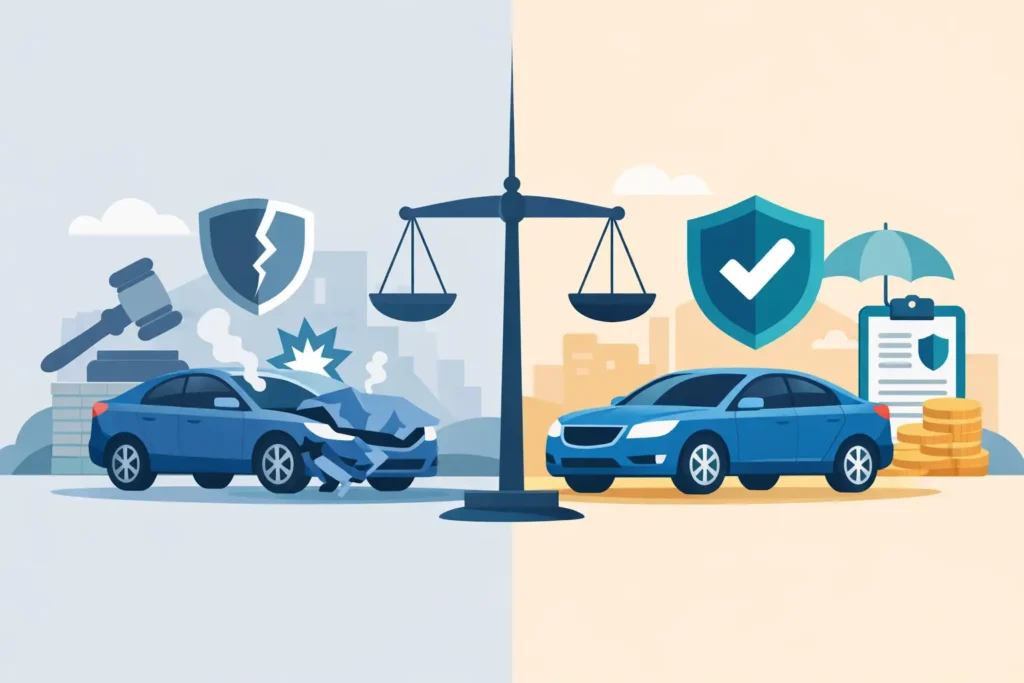
A low monthly premium can feel like a win right up until an accident leaves you paying thousands out of pocket. That is why the decision between liability versus full coverage is about more than meeting a legal requirement. It is about deciding which financial risks you can reasonably handle yourself and which ones you want your insurance policy to help carry.
For drivers in Texas and New Mexico, the right answer depends on your vehicle, your loan, your savings, your driving routine, and your comfort with risk. A local agent can make the choices clearer, but knowing the basics helps you make a smart move from the start.
Liability Versus Full Coverage: The Basic Difference
Liability insurance pays for injuries or property damage you cause to other people in a covered accident. It generally does not pay to repair or replace your own vehicle. If you rear-end another driver, for example, liability coverage can help pay for their medical bills and vehicle repairs up to your policy limits. Your own car repairs are your responsibility unless you have other applicable coverage.
Full coverage is a common phrase, not one specific policy type. Most people use it to mean a policy that includes liability coverage plus collision and comprehensive coverage. Collision helps pay for damage to your vehicle from a crash, whether you hit another car, a pole, or a guardrail. Comprehensive helps with many non-collision losses, such as theft, hail, fire, vandalism, falling objects, or an animal strike.
The phrase can be misleading because full coverage does not mean every possible loss is covered. Deductibles still apply to collision and comprehensive claims. Policy limits, exclusions, and optional coverages also matter. The better question is not whether a policy is called full coverage. It is what protections it actually includes and how they would work after a loss.
What Liability Coverage Is Designed to Protect
Liability coverage protects your finances when you are legally responsible for an accident. State minimum requirements set the floor, but minimum limits are not always enough for a serious crash.
Texas generally requires drivers to carry at least $30,000 in bodily injury liability per person, $60,000 per accident, and $25,000 for property damage. New Mexico generally requires at least $25,000 per person, $50,000 per accident, and $10,000 for property damage. Those amounts can be used quickly when multiple vehicles, newer cars, or significant injuries are involved.
Consider a crash where you cause damage to a newer SUV, another vehicle, and a roadside barrier. A low property damage limit may not cover the entire bill. If your liability limit is exhausted, you could be responsible for the remaining amount. Higher liability limits usually cost less than people expect compared with the additional protection they provide.
Liability-only coverage may make sense when your car has a low market value, is fully paid off, and you could afford to replace it if it were totaled. It can also be a practical choice for a vehicle that is rarely driven or kept as a backup. But it is not automatically the cheapest choice in the long run if losing that vehicle would create a major financial problem.
What Full Coverage Usually Adds
Collision and comprehensive protect the vehicle you own, subject to your deductible and the vehicle’s actual cash value. That matters when your car is essential for getting to work, taking kids to school, running a business, or crossing town every day.
Collision coverage can help after an at-fault accident or a single-car accident. If you slide into a curb during a storm or back into a post, liability coverage alone will not repair your vehicle. Collision may help, minus the deductible you selected.
Comprehensive coverage is especially worth discussing in West Texas and New Mexico, where weather and road conditions can create risks that have nothing to do with another driver. Hail, wind damage, flash flooding, broken glass, and animal collisions are all situations where comprehensive coverage may apply. A stolen vehicle or vandalism claim may also fall under comprehensive rather than collision.
If you finance or lease your vehicle, your lender or leasing company will usually require collision and comprehensive coverage. That requirement is part of your agreement, not a state insurance law. Dropping the coverage without replacing the loan can lead to lender-placed insurance, which is often expensive and may protect only the lender’s interest.
The Cost Question Is Really a Risk Question
Full coverage costs more because it protects more. The difference can be worthwhile if your vehicle would be difficult to replace, but it is fair to question the value as a car gets older.
Start with the vehicle’s current value, not what you originally paid for it. Then compare that value with the added annual cost of collision and comprehensive, along with your deductible. If your vehicle is worth several thousand dollars and you would struggle to buy another one after a total loss, keeping those coverages may be a smart decision.
On the other hand, paying a significant premium for physical damage coverage on a vehicle with very little value may not be the best use of your money. You could choose liability coverage and direct some of the savings toward an emergency fund. There is no universal mileage, age, or dollar amount that automatically tells you when to drop full coverage. Your financial situation matters more than a rule of thumb.
A higher deductible can lower the cost of collision and comprehensive coverage. It can be a useful way to keep protection while reducing your premium, as long as you have enough cash set aside to pay that deductible after a claim. Choosing a $1,000 deductible to save money only works if a $1,000 surprise expense would not derail your budget.
Do Not Overlook These Valuable Add-Ons
Whether you choose liability-only or a policy with collision and comprehensive, several coverages deserve a conversation. Uninsured and underinsured motorist coverage can help if another driver causes an accident but has no insurance or too little insurance. That is a real concern when medical costs and vehicle repairs can rise well beyond minimum limits.
Medical payments coverage or personal injury protection may help with medical expenses after a covered accident, depending on the coverage selected and state rules. Rental reimbursement can help pay for a temporary vehicle while yours is being repaired after a covered claim. Roadside assistance may be useful for drivers who want help with a tow, flat tire, dead battery, or lockout.
These options are not necessary for everyone, and they are not substitutes for strong liability limits. Still, they can make an accident less disruptive, particularly for families and working drivers who cannot easily go without transportation.
How to Choose the Coverage That Fits
Think through four practical questions before deciding. First, is your vehicle financed or leased? If yes, you will likely need collision and comprehensive. Second, could you replace the vehicle tomorrow without taking on debt or missing essential expenses? If no, physical damage coverage may be worth keeping.
Third, how much do you drive and where do you park? A daily commuter parked outdoors faces different exposure than a rarely used vehicle kept in a garage. Finally, look beyond your own car. Could a serious accident put your savings, income, or future assets at risk? If so, raising your liability limits may be one of the most valuable changes you can make.
Price should be part of the decision, but it should not be the only number you compare. Two policies can have similar premiums and very different deductibles, liability limits, rental coverage, or uninsured motorist protection. Ask for the pros and cons in plain language, then choose the option that fits your real-life budget and risk.
Farpon Insurance can compare options from multiple carriers and help you see where a lower premium may also mean less protection. You make the final call, but you should not have to sort through policy details alone.
The best policy is not the one with the shortest label or the lowest first price. It is the one that lets you drive with a clear plan for what happens if the unexpected shows up on the road.