
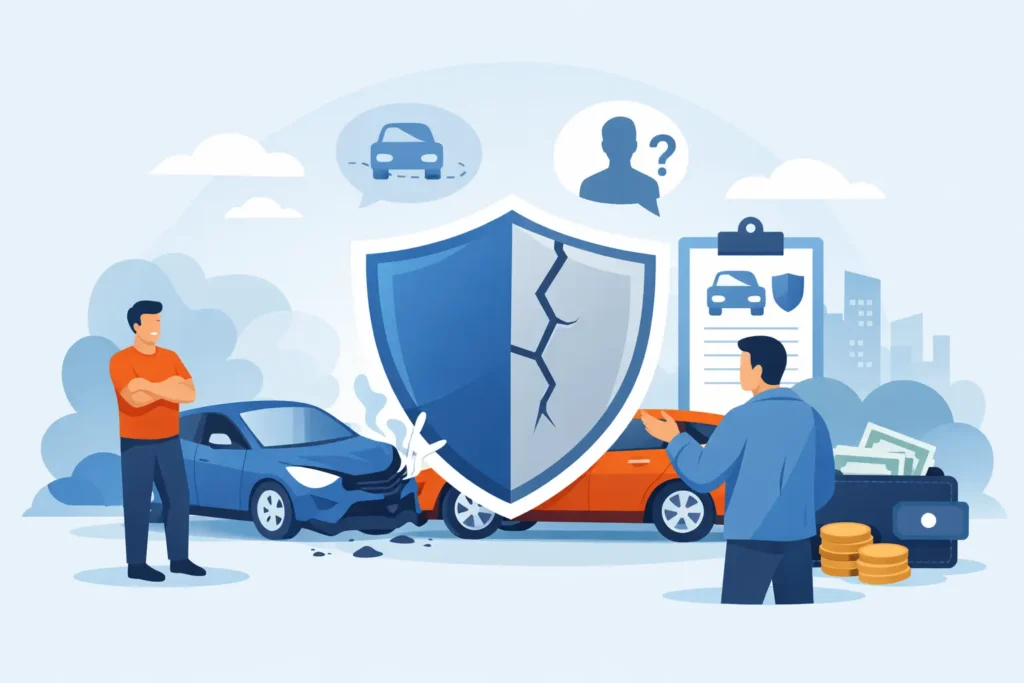
A wreck caused by another driver should not become your financial problem. Yet when that driver has no insurance, too little insurance, or leaves the scene, medical bills and lost income can land on your doorstep. This guide to uninsured motorist coverage explains the protection that can help Texas and New Mexico drivers make a smart move before that stressful moment arrives.
What uninsured motorist coverage does
Uninsured motorist coverage, often shown on a policy as UM, can pay for injuries you and your passengers suffer when the at-fault driver has no liability insurance. It can also apply in certain hit-and-run accidents when the other driver cannot be identified.
Underinsured motorist coverage, commonly called UIM, addresses a different but equally common problem: the other driver has insurance, but their liability limit is not enough to cover the harm they caused. UM and UIM are usually paired together, although the way benefits are calculated can vary by state and policy.
Depending on your policy, this coverage may help pay for medical expenses, rehabilitation, lost wages, pain and suffering, and in the worst cases, funeral expenses. It is designed to stand in for the liability coverage the responsible driver should have carried.
That distinction matters. Liability coverage pays for injuries or damage you cause to others. UM/UIM protects you when someone else causes the crash but cannot fully pay for it.
Why basic liability limits may not be enough
Texas requires drivers to carry liability insurance, but not every driver follows the law. Some motorists let their policy lapse. Others carry only the minimum required limits, which can be used up quickly after an emergency room visit, imaging, follow-up appointments, or time away from work.
New Mexico drivers face a similar risk. A serious crash on I-10, a busy El Paso-area intersection, or a rural highway can create costs far beyond a basic policy limit. The other driver may be uninsured, underinsured, or difficult to locate after a hit-and-run.
Consider a driver who causes $75,000 in injury-related losses but carries only $30,000 of bodily injury liability coverage. Without UIM coverage, the remaining $45,000 may be left to your health insurance, your own savings, or a legal claim against a person who may have little ability to pay. With the right UIM limit, your own auto policy may provide another source of recovery.
The exact amount available is not always as simple as subtracting one number from another. State rules and policy language affect how UIM benefits are determined. In New Mexico, for example, the available UIM amount may be affected by the at-fault driver’s liability limits. That is why choosing limits deserves more attention than checking the lowest-priced box.
Bodily injury coverage versus property damage coverage
Most drivers first think about medical bills, but uninsured motorist protection can involve two separate coverages.
Uninsured motorist bodily injury
UM bodily injury coverage helps with injuries to you and qualifying passengers. It may also protect you as a pedestrian or cyclist if an uninsured driver hits you. Coverage details vary, so it is worth reviewing who is insured under your policy and whether household family members are included.
This is generally the more critical part of UM/UIM coverage because injury costs can continue long after the vehicles have been repaired. A broken bone, concussion, back injury, or missed work can change a family’s finances quickly.
Uninsured motorist property damage
Uninsured motorist property damage, sometimes abbreviated UMPD, may help repair or replace your vehicle when an uninsured driver causes the damage. This protection is different from collision coverage.
Collision coverage can pay for damage to your vehicle after an accident regardless of who caused it, subject to your deductible. UMPD generally requires an uninsured at-fault driver and may have different eligibility rules, limits, or deductibles. It also may not apply in every hit-and-run situation. The availability and design of this coverage can differ between Texas and New Mexico, so the declarations page and policy terms matter.
If you finance or lease your vehicle, collision and comprehensive coverage may be required by the lender. Even if they are optional for you, they can work alongside UM/UIM to create a stronger overall safety net.
How much UM/UIM coverage should you carry?
There is no one limit that fits every household. The right choice depends on your income, savings, health insurance, family responsibilities, driving habits, and the vehicles you own. Still, a useful starting point is to consider UM/UIM limits that match your liability limits.
If you carry higher liability limits to protect your assets when you cause a crash, it often makes sense to consider comparable limits for injuries caused by an uninsured or underinsured driver. You are protecting the same household from a different direction.
For example, a policy might list bodily injury limits as $100,000 per person and $300,000 per accident. The first number is the most the policy may pay for one injured person. The second is the most it may pay for all injured people in the same accident. Higher options may be available, and the price difference can be more manageable than drivers expect.
Lower limits can reduce your premium, but they also reduce the cushion available after a major loss. Higher limits cost more, but they can be particularly valuable for families with teen drivers, commuters, self-employed workers, or anyone whose income would be affected by time away from work. The smart choice is the one that fits your budget without leaving a gap you would struggle to absorb.
Questions to ask before you decline coverage
In Texas and New Mexico, insurers generally must offer uninsured motorist coverage, and declining it involves specific requirements. Before signing a rejection form or choosing a minimal limit, pause and ask a few practical questions.
Could your household handle medical bills and lost income after a crash caused by someone with no insurance? Do you regularly carry family members, coworkers, or clients in your vehicle? Would you have enough money to replace or repair your car if an uninsured driver damaged it? Are your current limits based on an old policy choice rather than your present financial situation?
Also ask whether your policy covers hit-and-run losses, whether UMPD is included, what deductible applies, and how UIM benefits are calculated in your state. These are not minor details. They determine what happens after the claim is reported.
What to do after an uninsured-driver accident
Your first priority is safety. Call 911 if anyone is injured or if the crash needs a police response. Get medical care promptly, even if symptoms seem mild at first. Adrenaline can hide pain, and medical documentation can matter later.
If it is safe to do so, take photos of the vehicles, scene, license plates, road conditions, and visible injuries. Collect witness contact information and request the police report when it becomes available. Do not rely on the other driver’s verbal promise to pay later.
Report the claim to your insurance company as soon as practical. Be accurate, keep copies of bills and repair estimates, and ask what coverages may apply. A UM/UIM claim can involve more documentation than a simple repair claim, especially when there are injuries or when the at-fault driver’s insurer is also involved.
A policy review can uncover useful options
Auto insurance is easy to set and forget until a claim exposes a gap. A quick review can show whether your UM/UIM limits still fit your life, whether collision and UMPD overlap in a useful way, and whether changing deductibles or bundling policies could help balance cost and protection.
Farpon Insurance compares options from multiple carriers and explains the pros, tradeoffs, and pricing in plain language. You do not have to spend your weekend decoding policy abbreviations or calling insurer after insurer. Ask questions, compare the choices, and select coverage that lets you drive with more confidence. Con Orgullo Hablamos Español!
The best time to address an uninsured-driver risk is while you still have choices. A clear conversation about your limits today can make a hard day on the road far more manageable tomorrow.