
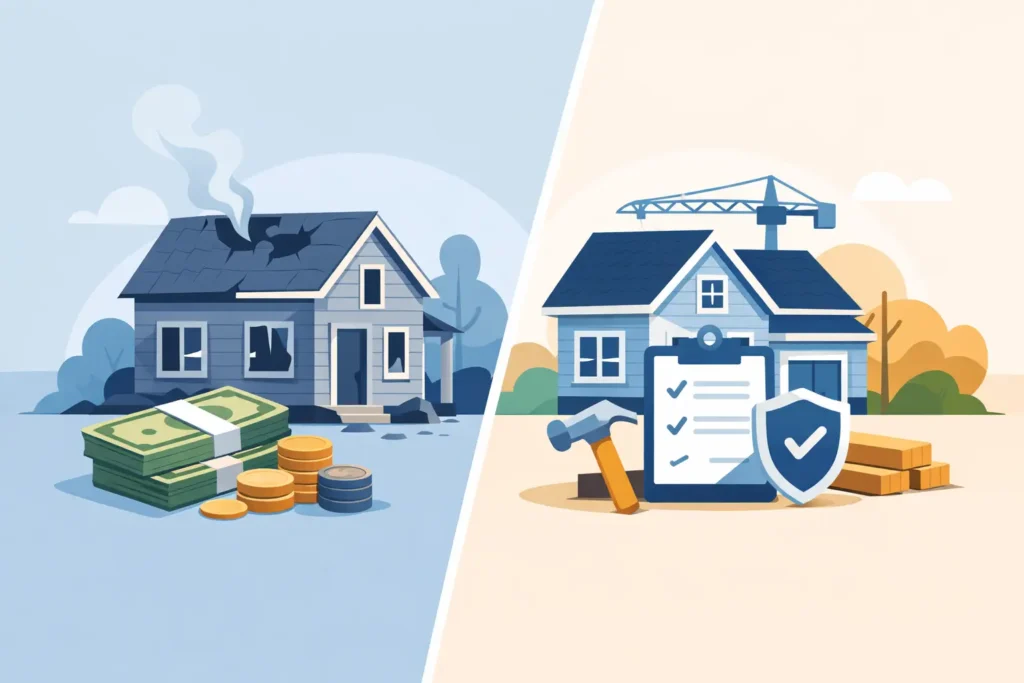
A hailstorm damages your roof. A kitchen fire ruins appliances. A burst pipe soaks furniture and flooring. In each situation, actual cash versus replacement cost can make a major difference in what your insurance claim pays – and how much you need to pay out of pocket to recover.
The names sound technical, but the choice comes down to one practical question: Does your policy pay for what your damaged property was worth just before the loss, or what it costs to replace it with a similar new item today? Make a Smart Move by understanding that answer before a claim puts you under pressure.
What actual cash value means
Actual cash value, often called ACV, pays the value of an item at the time it is damaged or destroyed. The insurer generally starts with the cost to replace the item, then subtracts depreciation for age, use, wear, and condition.
Think about a 10-year-old television that originally cost $1,000. A comparable new model may still cost close to $1,000, but your older TV was not worth that amount right before a covered loss. After depreciation, an actual cash value settlement might be several hundred dollars, minus your deductible.
The same idea can apply to a roof, flooring, furniture, clothing, tools, and other personal property. For a roof, age matters a great deal. If an older roof is damaged in a covered wind or hail claim, an ACV policy may pay less because the roof had already used up much of its expected life.
Actual cash value coverage usually comes with a lower premium. That lower upfront cost can make sense in some situations, particularly when you have a limited budget, own older property, or can comfortably handle a larger share of replacement costs after a loss. The tradeoff is clear: your claim payment may not be enough to buy all-new replacements.
What replacement cost means
Replacement cost coverage is designed to pay what it takes to repair or replace damaged property with materials of similar kind and quality, without subtracting depreciation. It does not mean you receive a luxury upgrade or a blank check. Your policy limits, deductibles, coverage terms, and the cost of comparable replacements still apply.
Using that television example, replacement cost coverage could pay the cost of a similar new TV, less your deductible. With a roof, it may pay the cost to replace covered damage using similar roofing materials, subject to the policy’s specific roof settlement terms.
Many homeowners policies provide replacement cost for the dwelling itself, but the details matter. Personal belongings may be covered on an actual cash value basis unless you choose a replacement cost endorsement. Roof coverage can also vary by carrier and policy. Some policies use replacement cost for roofs, while others use actual cash value or apply different rules once a roof reaches a certain age.
That is why a declaration page alone does not always tell the full story. The endorsement language, limitations, and coverage form matter just as much as the dollar amount shown next to your dwelling or personal property limit.
Actual cash versus replacement cost in a real claim
Here is a simplified example. A homeowner has a covered loss that destroys a five-year-old couch. A comparable new couch costs $2,500. The insurer determines the old couch had depreciated by $1,000.
With actual cash value coverage, the settlement for the couch would generally be $1,500 before the deductible. With replacement cost coverage, the total eligible payment could be up to $2,500 before the deductible, assuming the policy provides that coverage and the customer replaces the couch with a comparable item.
Replacement cost claims are often paid in stages. An insurer may first issue an actual cash value payment, then release the recoverable depreciation after you repair or replace the item and provide the required documentation. Policies can set deadlines for completing repairs or replacements, so ask your agent how your carrier handles this process.
Now consider a roof. If replacing a damaged roof costs $18,000 and depreciation is $7,000, the gap is not small. An actual cash value settlement may leave the homeowner responsible for that depreciation amount, plus the deductible. A replacement cost settlement may cover more of the work, but only if the damage is covered and the policy’s roof provisions support replacement cost.
Where this choice shows up
The replacement method can affect more than a homeowners policy. Renters insurance commonly gives you a choice between actual cash value and replacement cost for personal belongings. A renter with older furniture may accept ACV to keep premiums lower, while a family that would struggle to replace beds, electronics, clothing, and household essentials may value replacement cost coverage.
On a commercial property policy, business personal property may also be settled on an actual cash value or replacement cost basis. For a contractor, retailer, or small business, the difference can affect the ability to replace equipment, inventory, furniture, or fixtures after a covered loss. Business owners should also review whether their limits reflect current replacement prices, not what they paid years ago.
Auto insurance works differently in many cases. A standard comprehensive or collision claim for a totaled vehicle generally pays its actual cash value, not the price of a new vehicle. If you owe more on a loan or lease than the vehicle’s value, gap coverage may be worth discussing. New car replacement is a separate feature offered by some carriers and is not the same as standard replacement cost coverage.
How to choose the right option
There is no one answer for every household or business. The better choice depends on your budget before a loss and your ability to rebuild after one.
Replacement cost coverage often fits people who want more predictable recovery after a major claim. It can be especially helpful when replacing your belongings would create a serious financial burden. It may also be a strong consideration for homeowners with newer roofs or homes where current labor and material costs have risen well beyond the original purchase price.
Actual cash value may be a reasonable choice when the premium difference is meaningful and you have savings available to bridge the gap. It can also be appropriate for items that have already depreciated heavily. Still, choosing ACV simply because it makes a quote cheaper can be costly if you have not considered the potential claim shortfall.
Ask yourself a direct question: If a fire, windstorm, or water loss happened this month, could I replace what I need with an ACV payment after my deductible? If the answer is no, replacement cost deserves a closer look.
Four details to review before you buy
Coverage labels can be misleading if you do not look at the policy details. When comparing quotes, review these four points:
- Dwelling settlement: Confirm whether the home is insured on a replacement cost basis and whether extended or guaranteed replacement cost is available.
- Roof provisions: Ask how roof age, roof type, wind, hail, and depreciation affect a claim settlement.
- Personal property coverage: Check whether belongings are covered at actual cash value or replacement cost, and whether a replacement cost endorsement is included.
- Limits and deductibles: Replacement cost coverage cannot solve an underinsured limit, and a higher deductible still affects what you receive after a claim.
Also ask about special limits. Jewelry, firearms, collectibles, business equipment kept at home, and certain electronics may have coverage caps. A replacement cost settlement does not override those caps. Some property may need scheduled coverage or a separate endorsement.
Get clear answers before a claim
Insurance should not leave you guessing when you are already dealing with damage to your home, rental, or business. A good policy comparison looks beyond the premium and shows you what each option could mean when you actually need to file a claim.
Farpon Insurance can compare options from multiple carriers and explain the pros, cons, and policy language in plain English. Con Orgullo Hablamos Español! Before you choose a lower price, ask what settlement method comes with it. A short conversation now can help you protect your budget when life gets expensive fast.