
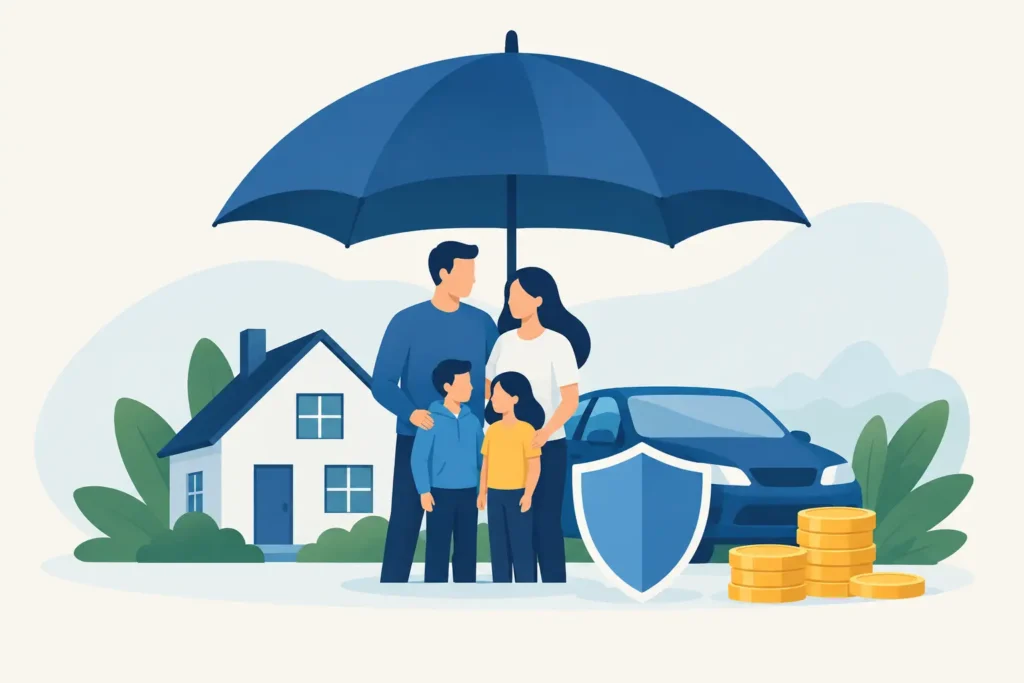
A serious accident can change the financial picture fast. If you cause a crash that injures several people, a guest is badly hurt at your home, or a claim turns into a lawsuit, the liability limit on your current policy may not be enough. Umbrella insurance is designed for that moment: it adds an extra layer of liability coverage above qualifying auto, home, renters, or other underlying policies.
For many families and business owners in El Paso, Texas, and New Mexico, the question is not whether they expect a major claim. It is whether their savings, home equity, future income, or business assets would be exposed if one happened. An umbrella policy can be a smart move when the answer is yes.
What Umbrella Insurance Actually Does
Personal umbrella insurance generally starts paying after the liability limit on an underlying policy has been used. Say you have auto liability coverage with a $250,000 limit and are found responsible for a much larger injury claim. After the auto policy pays up to its limit, a qualifying umbrella policy may provide additional coverage, subject to its terms and limits.
This coverage is about liability to other people. It is not extra coverage for damage to your own car, repairs to your own home, or your own medical bills. It is intended to help with covered injury or property-damage claims you are legally responsible for, along with certain legal defense costs. Depending on the policy, it may also address situations that a standard auto or homeowners policy handles more narrowly, such as personal injury claims involving defamation, libel, or slander.
Most personal umbrella policies are sold in increments beginning at $1 million. That can sound like a number reserved for wealthy households, but a lawsuit does not measure your finances before it measures the severity of the harm. Medical care, lost wages, attorneys, and long-term disability can add up quickly after a major accident.
Who Should Consider an Umbrella Policy?
Umbrella coverage is worth a conversation for people with assets to protect, but ownership alone is not the only factor. Risk can rise with everyday activities and life changes.
A household may be a strong candidate if it has teen drivers, multiple vehicles, a motorcycle, an RV, a swimming pool, a trampoline, a dog, rental property, or frequent guests. Drivers with longer commutes and families with young drivers often have more time on the road, which naturally means more opportunities for an accident. A homeowner may also face premises liability if someone is injured on the property.
It can also make sense for renters. You do not need to own a house to face a liability claim. Someone could be injured in your apartment, a pet-related incident could lead to a claim, or a car accident could exceed your auto policy limit. Renters may have fewer physical assets today, but wages and future earnings can still be at stake.
Business owners should look at their exposure separately. A personal umbrella policy usually does not cover claims arising from business operations. Contractors, truckers, retailers, landlords, and other commercial clients may need commercial umbrella or excess liability coverage. The right choice depends on the business, contracts, vehicles, employees, job sites, and the limits required by customers or regulators.
A Real-World Way to Think About the Risk
Imagine a driver runs a red light and causes a multi-car accident. Several people are injured, one needs surgery, and the claim reaches far beyond the driver’s auto liability limit. Without additional coverage, the driver could be personally responsible for the remaining amount.
Or consider a backyard gathering. A guest slips near the pool, suffers a serious injury, and alleges unsafe conditions. The homeowners policy may respond first, but its liability limit can be exhausted if the claim becomes expensive. An umbrella policy may provide another layer of protection when the underlying policy’s covered limit is no longer enough.
These examples do not mean every incident leads to a large payout. Claims depend on facts, state law, fault, injuries, policy language, and available coverage. Still, they show why liability limits deserve more attention than simply choosing the minimum required to get a policy issued.
The Limits Underneath Matter First
An umbrella policy is not a replacement for solid auto, home, or renters insurance. Carriers commonly require specific minimum liability limits on the policies beneath it. For example, they may require higher auto bodily injury and property damage limits, as well as a certain level of homeowners or renters liability coverage.
That requirement is not just paperwork. The umbrella is built to sit above those policies. If your underlying limits are lower than the umbrella carrier requires, you could have a gap during a claim. This is one reason it helps to review all policies together rather than adding umbrella coverage in isolation.
When comparing options, ask what liability limits are required on each underlying policy, which household members and vehicles must be listed, and whether recreational vehicles, rental properties, or watercraft need separate coverage. A policy that looks affordable at first may require changes elsewhere, so the full picture matters.
What an Umbrella Policy May Not Cover
Umbrella insurance is broad, but it is not a blank check. Intentional harm, criminal acts, and liability connected to many business activities are commonly excluded. Damage to your own property is not the point of the policy, either.
Certain high-risk items may require special review. Some policies limit or exclude specific dog breeds, watercraft, off-road vehicles, vacant homes, or rental situations. A teen driver, a new vehicle, or a property you begin renting out can also affect eligibility. Do not assume a policy automatically follows every change in your household.
There is another trade-off: umbrella coverage may not be the best first purchase if your basic liability limits are very low or your core insurance has major gaps. Raising auto and homeowners liability limits is often the first step. Then an umbrella can extend that stronger foundation.
How Much Coverage Is Enough?
There is no single number that fits every household. Start by looking at what could be vulnerable after a major claim: savings, investments, real estate equity, vehicles, future income, and, for business owners, company assets. Then consider your exposure. A family with two experienced drivers and no high-risk features may assess the need differently than a household with several vehicles, a pool, a young driver, and a rental home.
A $1 million limit is a common starting point, but higher limits may be appropriate when assets and liability exposure are greater. The goal is not to buy the largest number without thought. It is to choose a limit that makes sense for what you have built and the risks you take on each day.
Price is part of the decision, too. Umbrella policies can be relatively cost-effective compared with the amount of liability protection they add, particularly when bundled with qualifying policies. But premiums vary based on drivers, vehicles, properties, claims history, household risks, and carrier requirements. The lowest quote is only helpful if the coverage fits your situation.
Get the Whole Picture Before You Decide
The best umbrella insurance decision begins with a policy review, not a guess. Gather your auto, homeowners, renters, motorcycle, RV, and property insurance information. Think about recent changes: a new teen driver, a new home, a pool, a pet, a side business, a rental property, or more time on the road.
Then compare the available paths. An independent agency such as Farpon Insurance can review underlying limits, explain carrier requirements, and compare options without making you call insurer after insurer. You get clear pros, trade-offs, and a recommendation based on your needs and budget. Con Orgullo Hablamos Español!
A few minutes spent reviewing your liability protection can be easier than trying to rebuild financial security after an accident. Make a smart move: look at the coverage you already have, ask where it stops, and decide whether an extra layer would help you sit back and relax.